Potsdam's cultural landscape is one of the most beautiful of Germany's world heritage sites and, when combined with Berlin, is also the largest. The ensemble effect of the parks is truly unique; the system was created over centuries by order of Prussian electors, kings and emperors. Famous artists and structure and landscape architects left their mark on the complete artistic creation of gardens and buildings, interwoven in a diverse fashion with pathways and vantage points.
Since 1990,UNESCO granted large areas of Potsdam World Heritage status, including Sanssouci park, Neuer Garten, Babelsberg and Glienicke with their palaces, the Pfaueninsel (Peacock Island), and also the Sacrow palace and park, along with its Church of the Redeemer. Fourteen other listed areas were added to Potsdam's World Cultural Heritage list in 1999. Lindstedt palace and park, the Russian colony Alexandrowka, and the Pfingstberg with the Belvedere and the Sternwarte Astronomical Observatory in the Babelsberg park were among them.
Colognecathedralatnight


Dedicated to the saints Peter and Mary, Cologne Cathedral (Kölner Dom) is the seat of the Catholic Archbishop of Cologne. Cologne Cathedral is the greatest Gothic cathedral in Germany and has been Cologne's most famous landmark for centuries. Once the tallest building in the world, Cologne Cathedral still boasts the world's largest church façade.
The cathedral's main treasure is a golden reliquary containing the remains of the Three Magi of Christmas story fame. These relics and other treasures have made Cologne Cathedral a major pilgrimage destination for centuries.
History
Cologne Cathedral stands on the site of a 4th century Roman temple, followed by a square church known as the "oldest cathedral" commissioned by Maternus, the first Christian bishop of Cologne. A second church built on the site, the "Old Cathedral," was completed in 818. This burned down on April 30, 1248.
Construction of the present Gothic church began in the 13th century and took, with interruptions, more than 600 years to complete. The new structure was built to house the relics of the Three Magi, taken from Milan by Holy Roman Emperor Fredrick Barbarossa and given to the Archbishop of Cologne, Rainald von Dassel in 1164.
The foundation stone of Cologne Cathedral was laid on August 15, 1248, by Archbishop Konrad von Hochstaden, and the choir was consecrated in 1322. After this initial rapid progress, construction work gradually came to a standstill, and by the year 1560, only a torso had been built.
Only with the 19th century Romantic enthusiasm for the Middle Ages and the commitment of the Prussian Court did construction work resume. 1824 saw the addition of the towers and other substantial parts of the cathedral, mostly according to surviving medieval plans and drawings.
The completion of Germany's largest cathedral was celebrated as a national event in 1880, 632 years after construction had began. The celebration was attended by Emperor Wilhelm I.
The cathedral suffered 14 hits by World War II aerial bombs but did not collapse and reconstruction was completed in 1956. In the northwest tower's base, an emergency repair carried out with bad-quality brickstones taken from a nearby war ruin remained visible until the late 1990s as a reminder of the War, but then it was decided to reconstruct this section according to the original appearance. It is possible to climb a spiral staircase to a viewing platform about 98 metres above the ground.
In 1996, the cathedral was added to the UNESCO World Heritage List of culturally important sites and in 2004, it was placed on the "World Heritage in Danger" list.
What to See
The 19th century exterior of Cologne Cathedral is faithful to the original medieval plans, except for the modern steel roof. At its completion, Cologne Cathedral was the world's tallest building, overtaking the Cathedral of Strasbourg. In 1884, it lost the title to the Washington Monument, but Kölner Dom still boasts the largest church façade in the world.
The building is rarely completely free of scaffolding and renovation work, as wind, rain, and pollution slowly eat away at the stones. The Dombauhütte, which does the repairs, is said to employ the best stonemasons of the Rhineland.
Inside, the most celebrated work of art in the cathedral is the Sarcophagus of the Magi, a large gilded sarcophagus dating to around 1200. The largest reliquary in the western world, the exterior is seven feet of gilded silver and jewels. Images of Old Testament prophets line the bottom and the 12 apostles decorate the top. Inside, the reliquary holds three golden-crowned skulls believed to belong to the Three Magi.
These relics were acquired by Cologne in the 12th century and put the city on the pilgrimage map. Cologne Cathedral is still an important stop for modern pilgrims. The Three Magi do not play a large role in the life of Jesus, but they are honored for being the first pilgrims. Their precedent inspired medieval pilgrims to travel far to worship Jesus.
The Gero Cross (Gero-Kreuz), near the sacristy, is the oldest surviving monumental crucifix north of the Alps. Carved in 976 in a style ahead of its time, the crucifix depicts Jesus neither suffering nor triumphant, but with his eyes closed, dead. It is both a powerful religious image and a wonderful piece of art. With the Magi reliquary and the Madonna of Milan, the Gero Cross is one of the three major pilgrim stops in the cathedral.
The Chapel of the Virgin (Marienkapelle) contains The Patron Saints of Köln, painted in 1442 by Stefan Lochner. The painting is notable for its photographic realism (note the varieties of herbs in the foreground) and believable depth.
In the Sacrament Chapel is the Madonna of Milan (Mailänder Madonna), an elegant wooden sculpture depicting Mary and the child Jesus. Made in the Cologne Cathedral workshop around 1290, this High Gothic statue is associated with miracles and has attracted pilgrims for centuries. It is probably a replacement for an even older statue, which was brought to Cologne with the relics of the Three Magi by Rainald von Dassel and destroyed in the fire of 1248.
Another important statue of the Virgin Mary, which attracts the most attention from today's pilgrims and worshippers, is the miracle-working Jeweled Madonna in the north transept. Only the heads of the Virgin and Child can be seen; the remainder of the statue is dressed in a gown of white silk (last renewed in 1991) pinned with jewels and other ex-votos. The sculpture is Baroque and dates from the late 17th century.
The choir is surrounded by 13th and 14th century art: carved oak stalls, frescoed walls, painted statues and stained glass. The Treasury, outside the cathedral's left transept, is housed in the cathedral's 13th-century stone-cellar vaults. The six dim rooms contain a variety of glittering chalices, crosses, and reliquaries, plus fine examples of bishops' garb.
Pyramide de Khéops
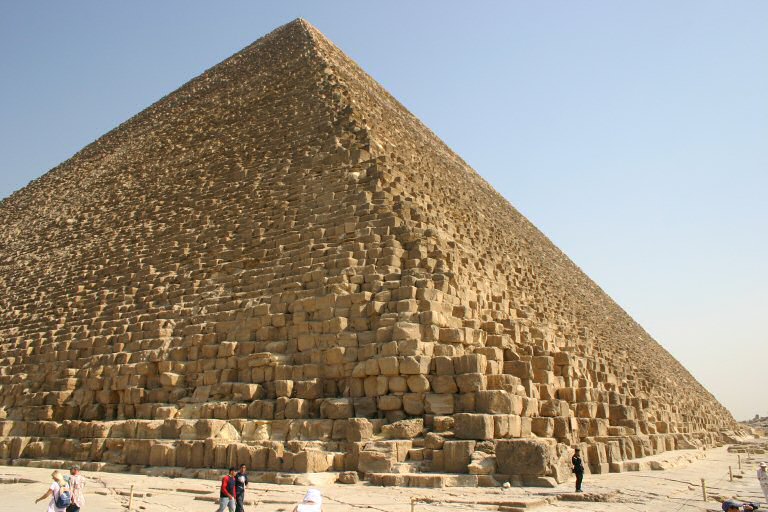
La pyramide de Khéops ou grande pyramide de Gizeh est un monument construit par les Égyptiens de l'Antiquité, formant une pyramide à base carrée de 137 m de hauteur[1]. Tombeau du pharaon Khéops, elle fut édifiée il y a plus de 4 500 ans, sous la IVe dynastie, au centre d'un vaste complexe funéraire se situant à Gizeh en Égypte.
Si elle est la seule des sept merveilles du monde de l'Antiquité à avoir survécu jusqu'à nos jours, elle est également la plus ancienne. Durant des millénaires, elle fut la construction humaine de tous les records : la plus haute, la plus volumineuse et la plus massive. Ce monument phare de l'Égypte est depuis plus de 4 500 ans scruté et étudié sans relâche. Le tombeau, véritable chef-d'œuvre de l'Ancien Empire égyptien, est la concentration et l'aboutissement de toutes les techniques architecturales mises au point depuis la création de l'architecture monumentale en pierre de taille par Imhotep pour la pyramide de son souverain Djéser. Toutefois, les nombreuses particularités architectoniques et les exploits atteints en font une pyramide à part qui ne cesse de captiver l'imagination des hommes.
Chola art
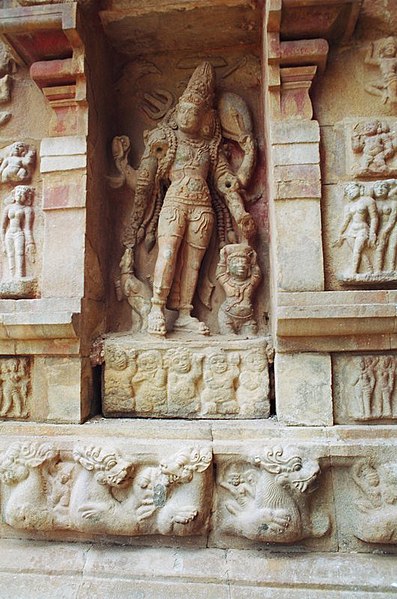
The period of the imperial Cholas (c. 850 CE - 1250 CE) was an age of continuous improvement and refinement of the Dravidian art and architecture. They utilised their prodigious wealth earned through their extensive conquests in building long-lasting stone temples and exquisite bronze sculptures. Most of these still stand proudly articulating those glorious days.
World Heritage Committee inscribes Russian site on World Heritage List and approves extension to Swiss site

The UNESCO World Heritage Committee meeting in Brasilia today inscribed a natural site in the Russian Federation on the World Heritage List and has approved the Italian extension of a natural site in Switzerland.
The two sites concerned (in order of inscription)
Monte San Giorgio (Italy) (Extension of «Monte San Giorgio », Switzerland)
Monte San Giorgio is a pyramid-shaped, wooded mountain that rises to an altitude of 1096 m above sea level and which lies to the south of Lake Lugano, in the canton of Ticino (Switzerland). The site is regarded as the best fossil record of marine life from the Triassic Period (245-230 million years ago). It was inscribed on the World Heritage List in 2003. The extension is contiguous with the existing site, on the Italian side of the border. The value of this extension lies in the exceptional importance and variety of its Triassic marine fossil record.
Putorana Plateau (Russian Federation)
This site coincides with the area of the Putoransky State Nature Reserve, and is located in the central part of the Putorana Plateau in northern Central Siberia. It is situated about 100 km north of the Arctic Circle. The part of the plateau inscribed on the World Heritage List harbours a complete set of subarctic and arctic ecosystems in an isolated mountain range, including pristine taiga, forest tundra, tundra and arctic desert systems, as well as untouched cold-water lake and river systems. A major reindeer migration route crosses the property, which represents an exceptional, large-scale and increasingly rare natural phenomenon.
These sites are in addition to 27 other natural, cultural and mixed sites inscribed or extended during the current session of the Committee in Sri Lanka, the United States of America, the United Republic of Tanzania, Saudi Arabia, Australia, India, Iran (2), Marshall Islands, Republic of Korea, Viet Nam, China (2), Tajikistan, France (2), Netherlands, Germany, Norway, Austria, Romania, Spain, Mexico (2), Brazil, Kiribati, Bulgaria.
The 34th session of the World Heritage Committee is being held under the chairmanship of the Minister of Culture from Brazil, João Luiz da Silva Ferreira. The meeting opened on 25 July and will continue through to 3 August. A total of 38 sites have been considered for inscription on the World Heritage List.
World Heritage Properties
Monte San Giorgio
Putorana Plateau
Committee Sessions
34th session of the Committee Jul 25, 2010 - Aug 3, 2010
Other news
World Heritage Committee also approves three extensions to World Heritage properties in Austria, Romania and Spain Aug 1, 2010
World Heritage Committee inscribes three new cultural sites, three natural sites and one extension on World Heritage List Aug 1, 2010
World Heritage Committee inscribes seven cultural sites on World Heritage List Jul 31, 2010
World Heritage Committee inscribes five new cultural sites on World Heritage List and approves two extensions to existing properties Jul 31, 2010
World Heritage Committee inscribes Ngorongoro Conservation Area (Tanzania) as Cultural World Heritage Site Jul 31, 2010
World Heritage Committee inscribes two new sites on World Heritage List Jul 30, 2010
Thirty-nine properties to be considered for inscription on UNESCO’s World Heritage List Jul 26, 2010
See Also
New Inscriptions
World Heritage List
Committee sessions
34th session (2010)
9th extraordinary session (2010)
33rd session (2009)
More sessions...
Committee Documents
Committee decisions
General Assembly
17th General Assembly (2009)
Forms
Nomination Form
Periodic Reporting
International Assistance
Resources
Convention Text
Operational Guidelines
WHC Information Kit
More
Contacts
Sitemap
Help/Faq
Useful Websites
Terms / Policies
And more
Become a member
Our Partners
World Heritage Review
World Heritage wall map
United Nations - Copyright © 1992-2010 UNESCO World Heritage Centre, All Rights Reserved | v3.0, Updated 03 Aug 2010
Calendar
News Archive
Global Strategy
Criteria
Tentative Lists
World Heritage List Nominations
World Heritage List
New Inscriptions
Interactive Map
World Heritage in Danger
The List in Danger
Success Stories
The Convention
Convention Text
Operational Guidelines
Model instrument of Ratification / Acceptance
The Committee
Sessions
Decisions Database
Rules of Procedure
The General Assembly
Sessions
Election FAQs
Rules of Procedure
Statutory Meetings
The States Parties
The Centre
Who's Who
The Advisory Bodies
Funding
International Assistance Request
Financial regulations
Reporting & Monitoring
State of Conservation
Periodic Reporting
Questionnaire 1 & 2
Asia & Pacific
Europe & North America
Reactive Monitoring
The Emblem
Activities
Group Tools
Periodicals
Review
Paper Series
Newsletter
Brochures & Info kits
Resource Manuals
Other materials
Wall Map
Donation
World Heritage and partnerships
What is PACT ?
Role of partners
Objectives and actions
FAQ
Our Partners
Become a Partner
Partnership Benefits
Partnership principles
Contact Us
Work/Volunteer
Jobs & Internships
Volunteer
Volunteer Organizations
Visit responsibly
Contacts
Who's Who
My profile
Documents
FAQ
Glossary
Search
Useful Websites
National Map Agencies
About this Website
Terms / Policies
Syndication
Site Map
Submit
Forgot your password?
Not a member yet?
订阅:
博文 (Atom)